June 7, 2026 • Adaeze Okonkwo • 9 min reading time • Prices verified June 18, 2026
Lands' End SlenderSuit vs. Budget One-Pieces: Is the $165 Price Gap Worth It for Plus Sizes?
You’ve measured yourself, you’ve sized up the options, and now you’re staring at a Lands’ End SlenderSuit priced around $130–$170 next to a $35–$55 budget one-piece from ASOS Curve or Amazon Essentials — and you’re asking the honest question: Is there actually $165 worth of difference here, or am I paying for a hang tag? That’s a completely fair thing to wonder. A one-piece swimsuit, for plus-size women especially, is doing a lot of structural work — managing bust support, torso length, hip-to-waist ratio (the difference between your hip measurement and your natural waist), and fabric recovery under real-world conditions like saltwater and repeated stretching. This article walks through exactly where the money goes, where it doesn’t, and which option makes the most sense depending on your specific fit priorities. We’ve organized the spec comparisons, owner feedback patterns, and construction details so you don’t have to cross-reference 30 product pages yourself.
What You’re Actually Comparing: Construction Tiers, Not Just Price Tags
Before we put numbers against numbers, it helps to understand what separates the two categories at a structural level — because “budget” and “premium mid-range” aren’t just price signals, they’re shorthand for different manufacturing decisions.
Budget One-Pieces ($30–$55)
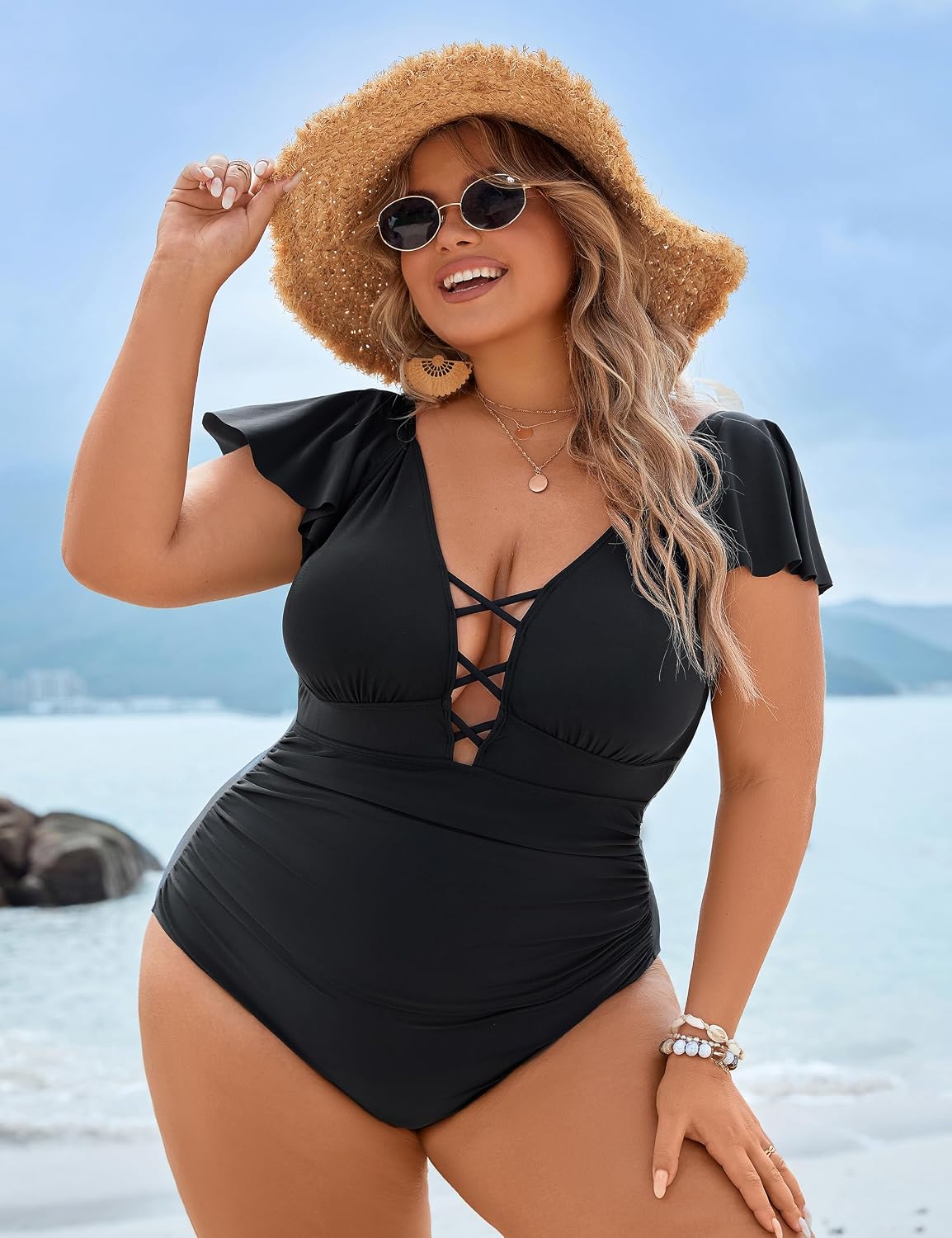
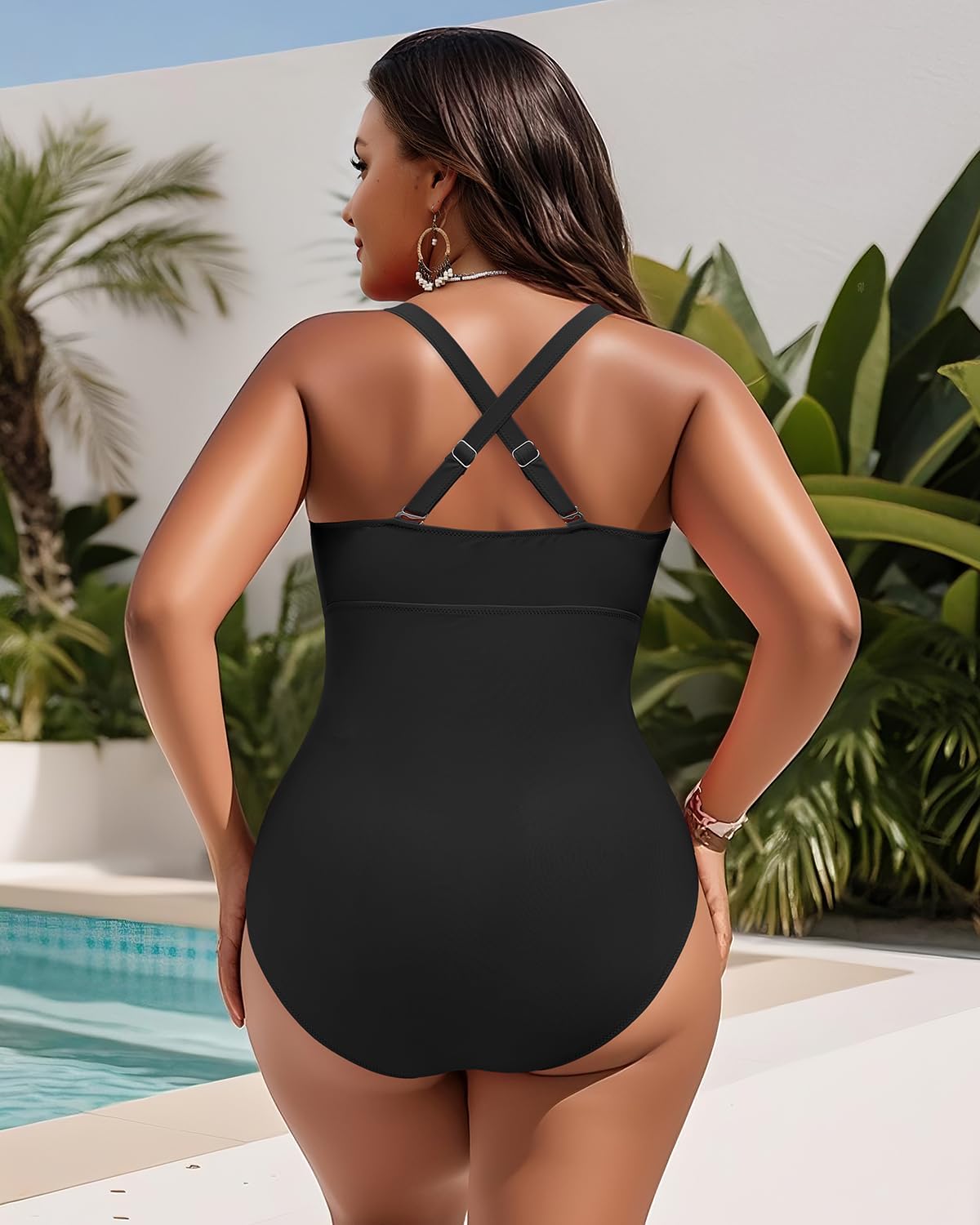
Brands in this tier — ASOS Curve, Amazon Essentials, Shein Curve, and some Target finds — are typically produced at high volume with commodity stretch fabrics, often a standard nylon/spandex blend running 78/22 or 80/20 by fiber content. Those blends stretch adequately but tend to lose elastic recovery faster, especially after saltwater or chlorine exposure. Bra construction in this tier usually means a soft shelf bra with a sewn-in foam cup — no underwire channel, no power mesh lining (a tighter, firmer inner fabric layer that adds compression without bulk). Straps are generally fixed-width and non-adjustable. Sizes may technically go to a 26 or 28, but grading (how the pattern scales up through sizes) is frequently uniform rather than proportional, meaning a size 22 isn’t just a bigger version of a size 14 — it may not account for the wider torso depth or the fuller bust projection that larger sizes require.
Blooming
$29.99
In stock on Amazon
Check price on AmazonThe Lands’ End SlenderSuit ($130–$170)
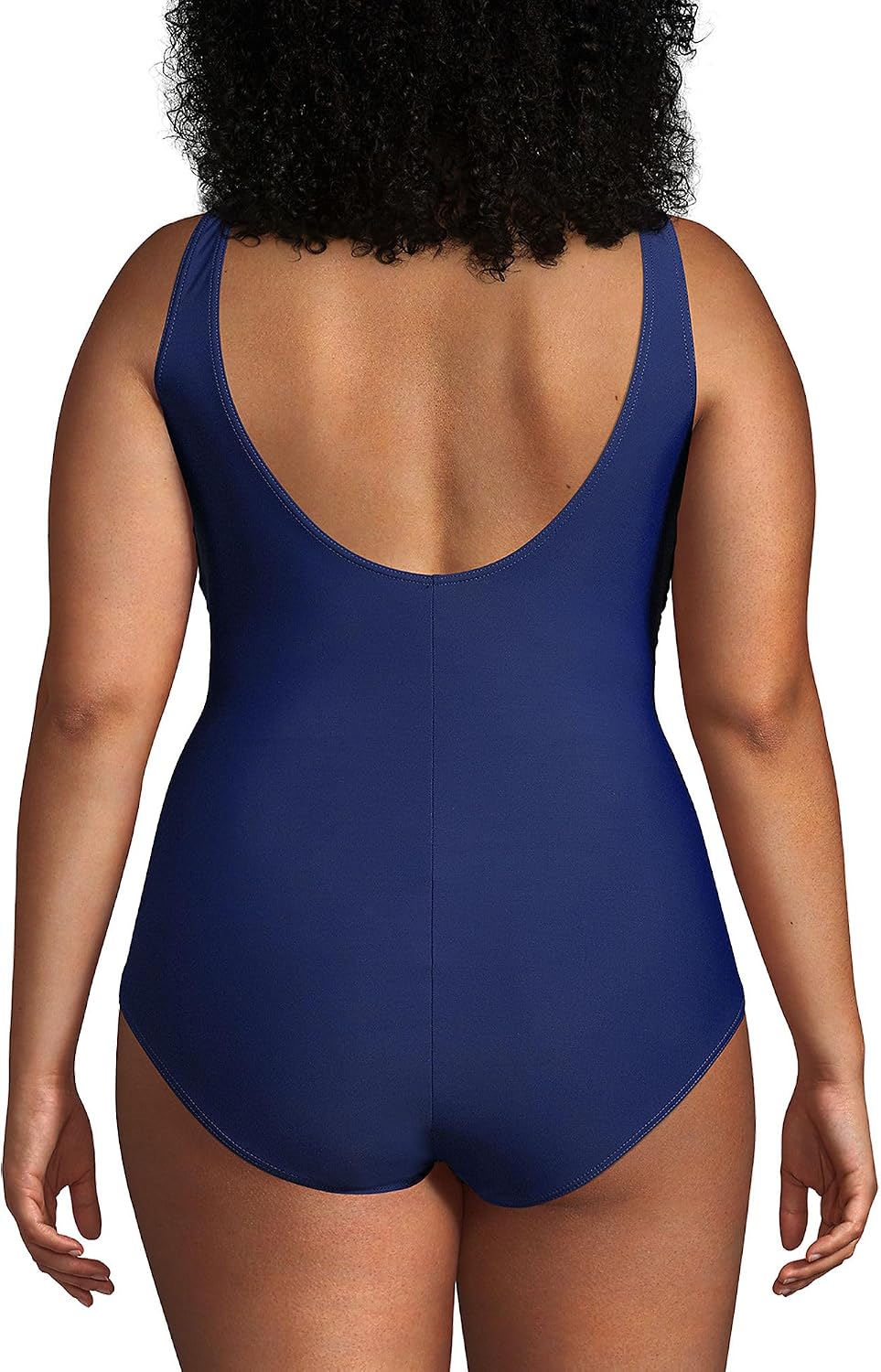
This suit sits in a genuinely different construction category despite being labeled “mid-range.” Based on Lands’ End’s published product specifications for the 2025–2026 season, the SlenderSuit uses a tummy-control power mesh inner liner bonded across the midsection, a bra with an underwire option on select styles, adjustable and convertible strap configurations, and their proprietary Tugless Tank construction that anchors the suit at the crotch to prevent the suit riding up — a chronic problem for longer-torso plus-size women. The fabric is a higher-denier nylon blend with Xtra Life Lycra, a DuPont-licensed fiber engineered for chlorine and saltwater resistance and rated to hold elasticity significantly longer than standard spandex under chemical exposure.
Yonique
$34.99
In stock on Amazon
Check price on AmazonHow the Two Tiers Stack Up Side by Side
| Feature | Budget Tier ($30–$55) | Lands’ End SlenderSuit ($130–$170) |
|---|---|---|
| Fabric fiber blend | Standard nylon/spandex | Nylon + Xtra Life Lycra |
| Inner lining | Shelf bra, foam cup | Power mesh tummy panel + optional underwire |
| Strap adjustability | Usually fixed | Adjustable, often convertible |
| Torso length options | Standard only | Regular and Long Torso available |
| Size grading (plus) | Uniform scale-up | Proportional grading through 26W |
| Return window | Varies (7–45 days) | Lands’ End: 1-year satisfaction guarantee |
Yonique
$34.99
In stock on Amazon
Check price on AmazonThat’s a meaningful difference in engineering. The question is whether that engineering translates to a meaningful difference for you — and that depends almost entirely on which structural fit challenges you’re actually dealing with.
Fit Architecture: Where Plus-Size Women Feel the Gap Most
Good Housekeeping’s “Best Plus-Size Swimsuits” roundup (updated March 2026) flags underwire channel integrity and strap architecture as the two factors most commonly cited in negative reviews of budget one-pieces for larger busts. That tracks with the pattern visible across aggregated owner feedback on major retail platforms.
Underwire Behavior at Larger Cup Sizes
Underwire behavior is a specific pressure point. Budget suits that include underwire — not all do — typically use a lightweight wire set into a simple channel without bartack stitching, the reinforcement stitch at the point where the wire meets the strap attachment. Without that reinforcement, wire ends migrate outward over time, especially under the mechanical stress of a larger bust. InStyle’s “Best Swimsuits for Large Busts” (June 2025) specifically notes this as a sizing-up problem: the forces on underwire channels increase nonlinearly with cup size, meaning what holds for a D cup at a budget price point may fail at an F or G cup. The SlenderSuit’s underwire styles, per Lands’ End’s published product specifications, include channel stitching and a wider underband to distribute load across a larger surface area.
Yonique
$34.99
In stock on Amazon
Check price on AmazonTorso Length and the Ride-Up Problem
Torso length is the other place where budget suits consistently underserve plus-size bodies. A standard-length suit on a longer torso creates constant upward pull — the suit is perpetually trying to shorten to its natural resting length, which translates to fabric riding up in the seat, shoulder straps pulling tight, and the bust cups shifting out of position. Lands’ End is one of a small number of retailers offering Long Torso sizing as a standalone option rather than a custom-order upcharge. Glamour’s “Best One-Piece Swimsuits for Every Body” (May 2025) called this out specifically as a persistent gap in the market that Lands’ End and a small number of specialty swimwear retailers address more consistently than budget-tier brands do.
Yonique
$34.99
In stock on Amazon
Check price on AmazonHip-to-Waist Differential and Seaming Decisions
Hip-to-waist differential is where seaming decisions matter most. Wirecutter’s “The Best Swimsuits” (updated April 2026) notes that for women with a differential of 14 inches or more between hip and natural waist measurement, straight-seam suits without side shaping or curved princess seaming will gap at the waist or compress the hip unevenly. Budget suits at this tier are almost universally straight-seam construction. The SlenderSuit uses side seaming with curve-adjusted panels — a manufacturing step that adds cost but meaningfully changes how the suit sits on a full-hip silhouette.
Yonique
$34.99
In stock on Amazon
Check price on AmazonWhere Budget Wins — And Where It Doesn’t
Budget one-pieces are not categorically wrong. They’re the right call in specific scenarios, and being honest about that is more useful than a blanket premium recommendation.
When the Budget Tier Is the Right Call
Budget one-pieces make sense when your fit challenges are mild and your use is occasional. If you’re a casual swimmer with fewer than ten wears per season, prioritize color variety and trend options over multi-year durability, and have a moderate bust, an average torso length, and a hip-to-waist differential under 12 inches, the structural engineering gap matters less because the structural demands are lower. Budget suits are also the right tool for experimentation — trying ruched, belted, or cut-out silhouettes before committing to a pricier version of what you actually like. Good Housekeeping’s March 2026 roundup specifically flagged ASOS Curve as delivering stronger-than-expected construction at its price point for swimmers without significant fit complexity.
Blooming
$29.99
In stock on Amazon
Check price on AmazonWhen the Budget Tier Costs You More Than You Save
Budget suits lose their value proposition when use is frequent and fit demands are high. Chlorine and saltwater degrade standard spandex faster than Xtra Life Lycra blends, and owners of budget suits in aggregated retail reviews consistently report loss of elasticity and cup shape by the end of one season with regular pool or ocean use. If you’re a G cup or larger and need real underwire architecture, the engineering gap is not cosmetic — it’s functional. A budget underwire at a larger cup size creates pressure points and wire migration that shoppers consistently describe as painful over a full day at the beach. The same applies to longer-torso women: budget suits don’t solve the ride-up problem, they transfer it to your strap tension. And for women with a pronounced hip-to-waist differential, curved seaming is a construction feature that budget manufacturing simply doesn’t budget for.
Blooming
$29.99
In stock on Amazon
Check price on AmazonThe Cost-Per-Season Math
The sticker price gap looks dramatic until you run cost-per-season numbers:
- Budget one-piece cost per season (assuming annual replacement with frequent use): approximately $35–$55 per year
- SlenderSuit cost per season (assuming three-to-four year lifespan with Xtra Life Lycra and proper rinse-and-dry care): approximately $35–$55 per year
The per-season cost difference narrows to near zero for frequent swimmers. For occasional swimmers who don’t stress the fabric as hard, the budget suit may genuinely last two seasons — in which case the budget tier wins on pure economics. Know your use pattern before you decide.
Blooming
$29.99
In stock on Amazon
Check price on AmazonThe Return Policy Factor (Often Underweighted)
One variable that tends to get buried in price comparisons: Lands’ End’s return policy is genuinely exceptional and changes the risk calculus on a $150 suit. As of the 2025–2026 season, Lands’ End publishes a one-year satisfaction guarantee with free returns, which means you can order a SlenderSuit in two torso lengths, try both at home, and return the one that doesn’t work without a restocking fee. That removes most of the purchase risk that makes a $150 swimsuit feel like a gamble.
Budget retailers vary dramatically. ASOS Curve’s return window as of spring 2026 is 45 days with free returns, which is reasonable for fit experimentation. Amazon’s return window on swimwear from third-party sellers can be as short as seven to thirty days depending on the individual seller, and hygiene policies vary — some sellers do not accept swimwear returns at all. If you plan to buy a budget suit to test a silhouette with the intention of returning it, verify the seller’s specific return policy before purchase, not after.
The Decision Rule: Matching Fit Complexity to Construction Tier
Here’s how to cut through the comparison without overthinking it.
If your fit challenges are structural — longer torso, larger cup size (E cup or above), hip-to-waist differential over 14 inches, or you swim frequently enough that chlorine resistance is a real durability factor — the SlenderSuit justifies the price. The construction gap is real, the per-season cost difference narrows over time with regular use, and the one-year return policy removes most of the financial risk. This is a case where the engineering is doing work that cheaper materials and simpler seaming genuinely cannot replicate.
If your fit challenges are mild and your use is occasional, a well-chosen budget one-piece from ASOS Curve or a Target house-brand option can absolutely serve you for a season or two. Spend the savings on a second suit in a different silhouette — that’s a better use of $80 than paying for durability engineering you won’t stress-test.
If you’re somewhere in between — one significant fit challenge but not several — consider timing your purchase around the Lands’ End sale cycle before defaulting to budget. Lands’ End runs consistent 40–50% off promotions in late June and late August as end-of-season clearance events, which typically brings the SlenderSuit into the $75–$95 range. At that price, the cost-per-use math tips decisively in the SlenderSuit’s favor even for moderate use, and the return policy still applies.
The $165 sticker gap sounds dramatic. The actual value gap is narrower, context-specific, and — for women dealing with multiple structural fit challenges — genuinely real. Know your challenges, match them to the construction tier that addresses them, and use that return window aggressively.