May 7, 2026 • Adaeze Okonkwo • 9 min reading time • Prices verified June 18, 2026
Shapewear Swimsuits for Plus Sizes: When Compression Helps and When It Fights Your Body
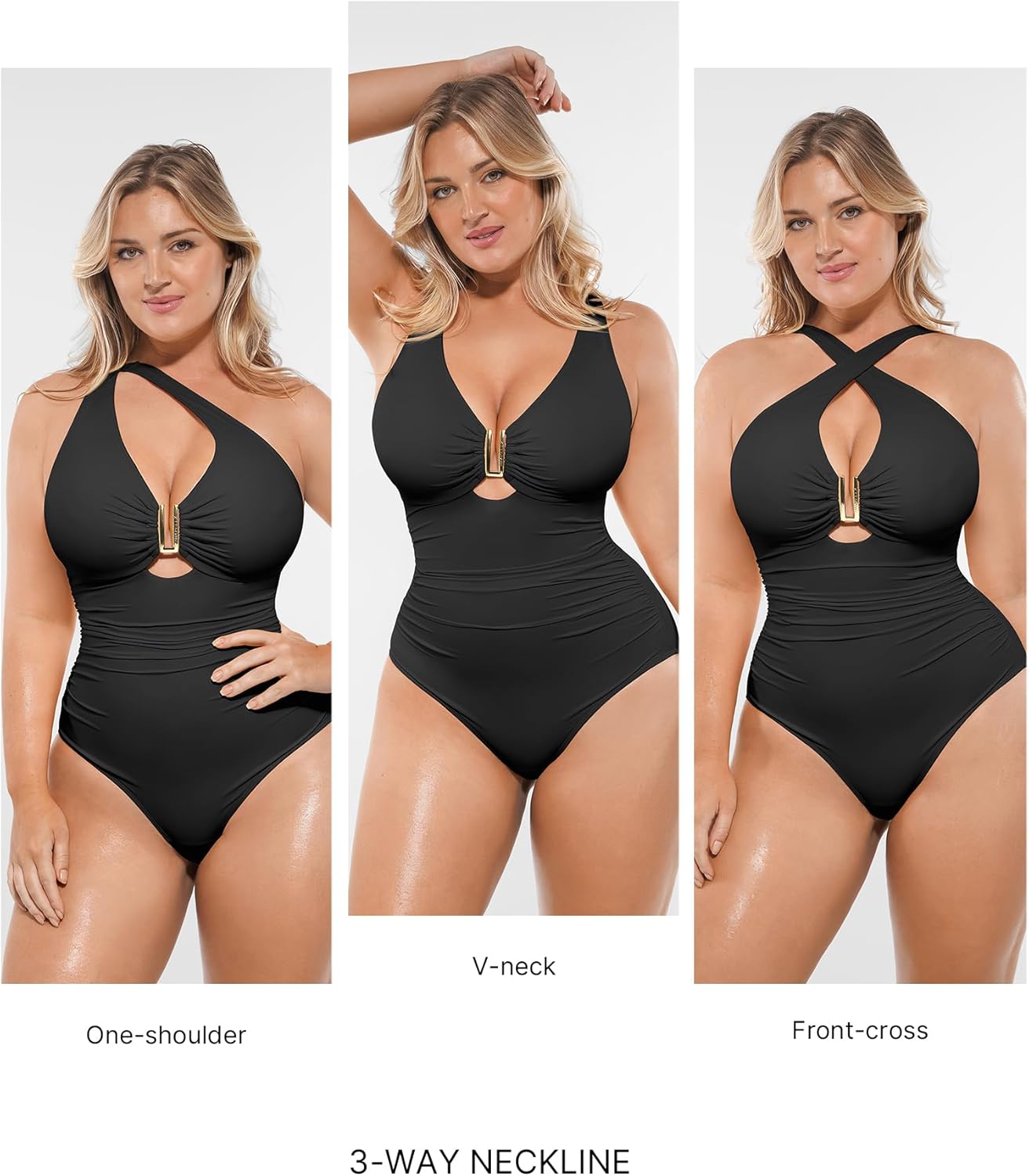
You’ve seen the marketing copy: firm control, tummy panel, sculpting technology. But if you’ve ever squeezed into a swimsuit that promised to smooth everything and found yourself unable to take a deep breath by the pool’s edge, you already know that compression — meaning fabric engineered to press against and hold the body — isn’t automatically your friend. The question isn’t whether a swimsuit has compression built in. The question is where the compression sits, how much it delivers, and whether that matches what your body actually needs. This guide is about decoding that distinction. We’ve organized the spec differences, the construction trade-offs, and the real-world feedback so you can make a confident call without sorting through thirty conflicting product pages.
If you’re already shopping in the $80–$220 range and you know what a tummy panel is, this is the level of detail you’ve been looking for. We’ll move fast.
| EDITOR'S PICK[SHAPELLX Tummy Control Swimsuit…](https://www.amazon.com/dp/B0G2RFJKY3?tag=greenflower20-20) | Mid-tier[SHAPELLX Womens Swimsuits Tummy…](https://www.amazon.com/dp/B0GT3LPTJC?tag=greenflower20-20) | Budget pick[SHAPELLX Tummy Control Swimsuit…](https://www.amazon.com/dp/B0G2RGGVHT?tag=greenflower20-20) | |
|---|---|---|---|
| Style | V-Neck Cutout | U-Ring | Plunge Cut Out |
| Color | Black | Black | Blue |
| Size | X-Large | Large | 3X-Large |
| Price | $60.79 | $58.99 | $47.99 |
| See on Amazon → | See on Amazon → | See on Amazon → |
What “Shapewear Swimwear” Actually Means Constructionally
Shapewear swimsuits aren’t a single category — they’re a spectrum of construction techniques that range from lightly supportive to clinically compressive. Here’s how the industry actually builds them:
Light control is typically achieved with a double-lined front panel — two layers of fabric rather than one — usually in the bust-to-hip zone. This adds modest smoothing without meaningfully changing silhouette or restricting movement. Most mid-range suits from Lands’ End and Swimsuits For All operate at this level.
Moderate control introduces a bonded or stitched internal panel — often called a “tummy panel” or “power mesh lining” — made from a denser, less-stretchy fabric than the outer shell. The panel is attached at the seams and lies flat against the body inside the suit. Miraclesuit’s signature construction falls here: their suits use a fabric called Miratex, which per InStyle’s 2024 feature on the brand, is described as providing “firm control equivalent to wearing a one-piece shapewear garment underneath your swimsuit.” That’s not hyperbole — it’s a meaningful compression level, and it has real trade-offs.
Firm control adds boning, wide elastic waistbanding, or multi-directional compression panels that run vertically as well as horizontally. Anita Care and some Gottex constructions use this approach for their larger-cup suits. Firm control genuinely restructures silhouette but also creates the most wearability friction — we’ll get to that.
The fiber matters as much as the construction. Xtra Life Lycra (a Lycra brand specification) retains its elasticity longer under repeated stretch-and-recover cycles than standard spandex, per published fiber specifications from Invista (Lycra’s parent company). Carvico’s Vita fabric, frequently used in European premium suits, similarly emphasizes chlorine resistance alongside compression recovery. A suit using budget-grade spandex will lose compression meaningfully after 20–30 wears in chlorinated water — reviewers at Good Housekeeping’s 2025 swimsuit roundup flag this as the most common long-term complaint with lower-priced shapewear suits.
When Compression Actually Works For You
Compression helps when it targets the right zone for your body and delivers the right intensity for your activity. Here’s the honest breakdown:
It works for bust support on larger cup sizes (D and above). This is compression’s most defensible application in swimwear. A suit with structured underwire and a firm chest band — like the Anita Care underwire one-piece architecture — uses compression mechanically: the wire lifts, the band anchors, and the strap distributes weight. Owners of Anita’s larger-bust suits consistently report that the structured compression at the chest reduces shoulder fatigue significantly compared to soft-cup alternatives. That’s compression doing actual engineering work.
It works for hip-and-thigh smoothing when you’re relatively stationary. If you’re on a beach chair or a boat deck rather than doing laps, moderate panel compression at the hip and upper thigh delivers on its visual promise without creating the ventilation problem we’ll discuss in a moment. Refinery29’s 2024 piece on shapewear swimsuits notes that the most-praised use case from readers was “resort wear and cruise settings” rather than active beach days.
It works when the compression zone matches your fit concern — not just wherever the manufacturer placed the panel. This is the most important practitioner-level distinction. A tummy panel that sits too high will compress your ribcage rather than your midsection. A panel placed too low misses the lower belly entirely. Self.com’s 2024 compression swimwear overview specifically flags this: “The panel placement in off-the-rack shapewear swimsuits is calibrated for an average torso length that may not match yours.” If you’ve measured your torso and know it runs long or short, this matters before you buy.
By the numbers — compression intensity at common price points:
| Construction Level | Typical Price Range | Panel Material | Realistic Wearability Window |
|---|---|---|---|
| Light (double-lining) | $45–$90 | Standard nylon/spandex | Full-day active |
| Moderate (power mesh) | $90–$160 | Power mesh + Xtra Life Lycra | 4–6 hours comfortable |
| Firm (bonded panel + boning) | $150–$260+ | Miratex / structured mesh | 2–4 hours, rest recommended |
When Compression Fights Your Body
This is where honest editorial guidance diverges from marketing language, and it’s the section worth reading twice.
Firm all-over compression creates a heat and moisture problem for larger bodies. When compression fabric sits densely against a large surface area of skin, it restricts the natural evaporation of moisture. This isn’t a styling issue — it becomes a physical comfort issue, especially in direct sun, especially above a size 20W where the surface area involved is meaningfully larger. Reviewers in the Glamour 2025 plus-size swimsuit roundup consistently describe firm-panel suits as “exhausting to wear for more than a few hours,” and several note feeling overheated in ways they didn’t experience in non-compressive suits.
Compression that targets the wrong axis pulls the suit out of alignment. Here’s a specific failure mode that owners of fuller-figure suits report frequently: a tummy panel engineered for horizontal compression (side-to-side smoothing) on a body with a significant hip-to-waist differential (14+ inches is common in this size range) creates lateral tension that pulls the suit’s center seam off-axis. The suit twists. The underwire shifts. The straps go asymmetric. This isn’t a sizing problem — it’s a construction mismatch. Per Glamour’s 2025 roundup, this is one of the top complaints for hourglass and pear-shaped figures in shapewear suits.
High-waist compression panels can compromise underwire channel positioning. If you’re wearing a shapewear one-piece with a firm midsection panel and underwire, those two systems need to work in the same direction. When a panel is anchored at the waist seam and pulls downward while underwire channels are designed to stay lifted, the competing tension can cause the wire to migrate — eventually breaking through the channel at the bartack (the reinforced stitching point where the wire meets the strap attachment). This is a durability issue, not just a comfort one. It’s why several premium brands — Magicsuit in particular — engineer their suits so that compression and underwire zones are deliberately separated, with soft construction at the bust and structured panels below, never overlapping. InStyle’s 2024 Miraclesuit vs. Magicsuit comparison describes this as “the single most consequential construction decision” separating the two brands.
Compression sized down is not compression — it’s restriction. This seems obvious, but it’s where a lot of purchasing decisions go wrong. The appeal of sizing down in a shapewear suit is real: the suit looks smoother on the hanger and the compression panel feels more firm. But compression fabric has a calibrated recovery ratio — it’s designed to compress x amount from its relaxed state. When you size down, you’re adding tension that isn’t engineered into the panel, and that excess tension redistributes to seam stress points. Owners consistently report that undersized compression suits develop seam failure, panel rolling, or boning migration faster than correctly sized suits.
The Decision Framework: If X, Then Y
You’re looking at a specific suit or category. Here’s how to route your decision:
If your primary concern is bust support (D cup and above): Prioritize underwire architecture and structured chest compression over tummy panels. Look for suits where the compression stops at the underbust rather than running continuously. Anita Care and Freya’s swimwear lines are built around this logic. Pass on suits where the compression panel runs from hip to bust in a single uninterrupted layer — that’s a construction designed for smaller busts.
If your primary concern is tummy smoothing and you have a 14+ inch hip-to-waist differential: Look for suits with vertical-cut panels rather than horizontal-only panels. Vertical seaming accommodates the differential instead of fighting it. Miraclesuit’s ruched-side constructions are specifically designed for this, per the brand’s published fit guides. Avoid suits where the tummy panel is a single flat rectangle — that’s built for a more columnar silhouette.
If you’re shopping for active beach use (swimming, playing with kids, moving constantly): Stay at light-to-moderate compression. A power mesh lining is plenty. Firm control suits will fatigue you before the afternoon is over and are significantly harder to adjust or re-position when they shift.
If you’re shopping for resort or stationary wear where appearance is the priority: Moderate-to-firm compression is reasonable, with a deliberate time ceiling. Plan to bring a cover-up. The suits deliver on their visual promise in that context — reviewers across Good Housekeeping’s and Glamour’s roundups confirm this consistently.
If you’re between sizes in a shapewear suit: Size up, always. The compression is engineered for the correct size. A suit that fits at the hips but feels tight across the ribcage is telling you the compression is already maxed out, and it will degrade faster.
If the suit you’re considering has an internal panel but no information about what it’s made of: That’s a flag. Brands that invest in quality compression materials — power mesh, Miratex, Carvico — name them in their product descriptions. Generic “built-in control” language with no fiber specifics usually means standard double-lining at best, or a flimsy insert that rolls after three wears.
Shapewear swimwear is a genuinely useful category when the construction matches the body and the use case. The mistake isn’t choosing compression — it’s choosing compression without a clear map of where it’s going and what it’s meant to do. Match the zone, match the intensity, and size correctly: that’s the whole decision framework. The suits that get it right are worth every dollar of their premium. The ones that don’t will remind you of that fact about two hours into a hot afternoon.